Why I love Cuyabeno (and think you will too)
Hi, I’m Marco. I’ve been sending travellers into the Ecuadorian Amazon for years, and Cuyabeno is still the trip I talk about with the biggest smile.
My favourite moment there isn’t even an animal. It’s jumping into the lagoon at sunset, with the jungle all around you and the sky turning orange. You spend your days in rubber boots and mud, with no phone, no notifications and no worries. It’s a kind of peace you don’t get many places anymore.
I’ll be honest with you too: I’ve been to Cuyabeno and I still haven’t seen an anaconda myself. That’s the jungle. Nothing is guaranteed, and that’s part of what makes every sighting so special.
Below I’ve put everything friends ask me before they go: where it is, which tour to pick, what you’ll eat, what to bring and whether it’s safe.
Where is Cuyabeno and how do you get there?
Cuyabeno Wildlife Reserve is a protected area of Amazon rainforest in the province of Sucumbíos, in the northeast of Ecuador, near the borders with Colombia and Peru. It’s a huge system of rivers, lagoons and flooded forest, and you explore most of it by canoe.
The easiest way in is our overnight bus from Quito, and honestly it’s been a blessing:
- It leaves from Community Hostel in Quito’s Old Town between 10:30 and 11pm.
- You sleep on the way. The seats recline, and the bus stops for the bathroom and food.
- You arrive at Puente de Cuyabeno, the entrance to the reserve, around 9 to 10am.
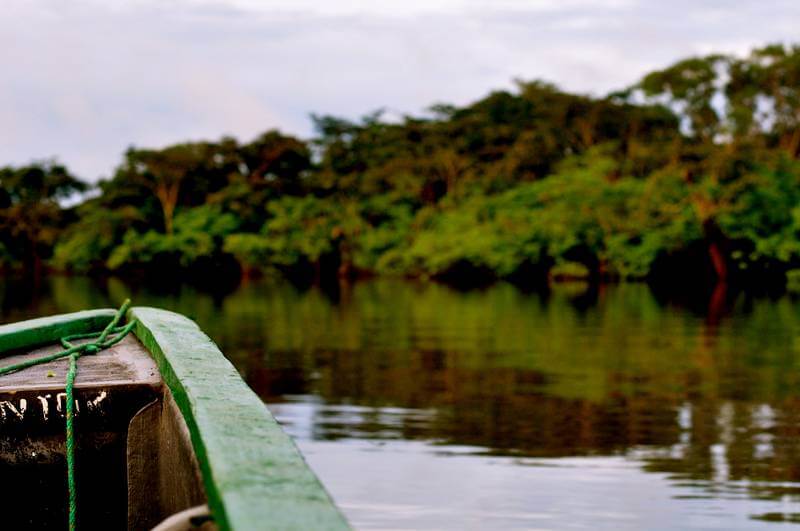
- Your jungle tour starts at about 11am, and a canoe takes you about two hours into the jungle to Cuyabeno Dolphin Lodge. I love this part, because the tour really starts the moment you step into the canoe. Your guide starts pointing things out right away, and you’re already spotting wildlife on the way in.
The bus is only for people going to the jungle, so it’s almost all travellers like you. If someone leaves something behind, it comes back to them. The return transfer costs $75 per person, or you can travel on your own in daylight if you prefer.
Which Cuyabeno tour is best: 3, 4 or 5 days?
If you can, do the 4 days. That’s what I tell my friends. The 3-day tour is great if you’re short on time, but it doesn’t include the visit to the Siona community, and for me that day is one of the most special parts of the trip.
| Tour | Price per person | Siona community and shaman visit |
|---|---|---|
| 3 days | $310 | No |
| 4 days | $350 | Yes, a full day |
| 5 days | $420 | Yes |
All tours stay at Cuyabeno Dolphin Lodge, and a private double room is about $20 extra per person. The community visit has an entry fee of $20 per person ($10 for the community and $10 for the shaman), which isn’t included in the tour price. The 5-day tour gives you one more day in the jungle, on day 4, with more time canoeing and an afternoon swimming out in the lagoon.
Coming as a couple, family or group and want the trip to yourselves? Ask me about a private Cuyabeno tour. We can plan the dates around you and pick you up and drop you off wherever you’re staying in Quito.
Will I visit an indigenous community?
Yes, on the 4 and 5-day tours. We visit the Siona people of Tarabeaya, who live inside the reserve.
They welcome you with fruit from the area, and then you make pan de yuca (cassava bread) together. The kids sell crafts they’ve made, so bring some small bills if you’d like to support them. It isn’t a show. It’s a real community opening their home to you for the day.
What is a shaman, and will I meet one?
A shaman is a spiritual healer and keeper of traditional knowledge, especially about the plants of the forest. On our 4 and 5-day tours you meet the Siona shaman. The shaman does a limpia, a traditional cleansing ceremony, and explains how the Siona live in the jungle. It’s a moment you won’t forget.
What animals will I see?
I want you to come with the right expectations, because I’d rather you be amazed than disappointed. Guests do see anacondas, sloths and pink river dolphins in Cuyabeno, along with monkeys and lots of birds. But this is wild jungle, not a zoo. You go out with your guide to look for them, and no animal is ever guaranteed.
Will I see an anaconda?
Maybe, and your odds depend on the season. In the dry season, from mid-October to about April, the water is lower and you see more land animals and cold-blooded ones like the big anacondas.
When is the best time to go to Cuyabeno?
Honestly, there’s no bad time. Cuyabeno has two seasons:
- Dry season, from mid-October to about April. It’s easier to find animals that are harder to spot the rest of the year, like anacondas and other land animals.
- Rainy season, the rest of the year. The rain doesn’t last all day. It usually rains for an hour and then the sun comes back out. The lagoons are full, which is beautiful for canoeing.
So come whenever your trip allows. The dry months just change which animals are easier to see.
Are there piranhas, and can I fish for them?
There are piranhas in the Amazon, but fishing isn’t allowed in Cuyabeno. It’s a protected reserve, and we respect that. You can swim in the lagoon, though, and I really hope you do it at sunset.
Food, the lodge and what to bring
What will I eat?
All your meals are included from the moment you arrive at the lodge until you leave it. We can do vegetarian, vegan and gluten-free food, so just tell us when you book and the kitchen will look after you.
What’s the lodge like?
Cuyabeno Dolphin Lodge sits right in the middle of the jungle, so it runs on solar panels and generators. The lights are on during the hours you need them most, and there’s a spot in the restaurant to charge your phone and camera. You get hot showers and mosquito nets over your bed. There is wifi, but it costs extra per device per day, and I’d honestly encourage you to switch off for a few days.
Should I bring rain gear?
You don’t need to buy anything special. We give you rubber boots and a rain poncho at the lodge, because it’s the rainforest and it will rain. Here’s what I’d pack:
- Light, quick-dry clothes, including long sleeves and long trousers for the mosquitoes
- Insect repellent and sunscreen
- A headlamp or small flashlight
- A swimsuit for the lagoon
- A power bank and a dry bag for your phone
- Some small bills for the community crafts
- Socks that come up above the boots
Is Cuyabeno safe?
Yes. I wouldn’t send my friends there otherwise. In all our years of running Cuyabeno tours, we’ve had zero incidents with our drivers and no accidents, either on the road or at the lodge.
Here’s why I feel good about it:
- The overnight bus only carries people going to the jungle, it stops for breaks, and it has a great track record.
- You’re with a local guide the whole time you’re out in the forest and on the water.
- The lodge has emergency communication by satellite phone or Starlink, so help can always be reached.
- Cuyabeno is a protected reserve, and the communities inside it welcome visitors.
Do I need malaria pills or shots?
We’ve never had a guest get malaria. You don’t have to take pills, but if it gives you peace of mind, go for it and take them the way your doctor recommends.
The best everyday protection is simple: long sleeves in the evening, repellent, and the mosquito net over your bed.
Questions friends ask me about Cuyabeno
Where is Cuyabeno?
In Sucumbíos province, in the northeast of Ecuador’s Amazon, near the borders with Colombia and Peru. Our overnight bus gets you there from Quito by the next morning.
Which Cuyabeno tour is the best?
The 4-day tour, if you have the time. It includes a full day with the Siona community and the shaman. The 3-day tour doesn’t include the community visit.
Do I visit an indigenous community?
Yes, on the 4 and 5-day tours you visit the Siona community of Tarabeaya. You make cassava bread, try local fruit and meet the shaman.
Will I see an anaconda?
You might. Big anacondas are easiest to spot in the dry season, from mid-October to about April. No animal is ever guaranteed, because this is wild jungle.
Can I swim or fish in Cuyabeno?
You can swim in the lagoon. Fishing, including for piranhas, isn’t allowed because Cuyabeno is a protected reserve.
Is Cuyabeno dangerous?
No. We’ve had zero incidents and no accidents on our transport or at the lodge, you’re always with a guide, and the lodge has emergency satellite or Starlink communication.
Do I need malaria pills?
We’ve never had a guest get malaria. Pills are optional. If they give you peace of mind, take them as your doctor recommends.
Can I get vegetarian, vegan or gluten-free food?
Yes, all three. Just let us know when you book.
Is there wifi and electricity?
The lodge runs on solar panels and generators, with a charging spot in the restaurant and hot showers. Wifi is available for an extra fee per device per day.
What if my plans change?
It happens to all of us. For jungle tours, if you cancel at least 10 days before the tour, you get a full refund. After that, the lodge has already reserved everything for you, so cancellations cost 100% of the tour price. That’s one more reason I’d recommend travel insurance. Just message us as early as you can and we’ll do our best to help.
How do I book?
Book on our Cuyabeno jungle tour page or message us on WhatsApp at +593 97 998 4730. You’ll talk to a real person on our team in Quito. For us it’s not about selling you a tour. It’s about you having the best experience you can while you’re in Ecuador.