Quick answer: The best waterfall hikes in Ecuador are Pailón del Diablo and the Ruta de las Cascadas near Baños, Mindo’s seven-fall Santuario de Cascadas, Cóndor Machay near Sangolquí (3 hours round trip), Peguche near Otavalo (an easy walk) and Las Latas near Misahuallí. San Rafael Falls collapsed in 2020 and can no longer be visited.
Updated September 2026 by our local guides in Quito: new at-a-glance table, current entry fees where we could confirm them, and the real status of San Rafael Falls.
We send travelers to these waterfalls every week from our office in Quito’s Old Town, so below is the quick version of what we tell them at the front desk: how far each hike is, how hard it feels, and what you will pay at the gate as of 2026. Where a fee is small and changes often, we say so instead of guessing.
Best waterfall hikes in Ecuador at a glance (2026)
| Waterfall | Region / nearest town | Hike length or time | Difficulty | Entry fee (as of 2026) | From Quito (approx.) |
|---|---|---|---|---|---|
| Pailón del Diablo | Tungurahua / Río Verde, 18 km past Baños | About 1 km trail each way, 45–90 min total | Easy to moderate (steep steps back up) | Around $2–3 adults depending on the entrance | 4 h by road |
| Ruta de las Cascadas | Baños to Río Verde | 18 km downhill by bike, 3–5 h with stops | Easy (mostly downhill) | Most falls free; Manto de la Novia cable car about $2 | 3.5 h to Baños |
| Santuario de Cascadas (7 falls) | Pichincha / Mindo | 3–5 h for the full circuit | Moderate (muddy, slippery) | Tarabita cable car about $5 round trip | 2 h |
| Cóndor Machay | Pichincha / Rumipamba, 17 km from Sangolquí | About 1.5 h each way, 3 h round trip | Moderate (river crossings on bridges) | No trail fee confirmed; parking about $1 | 1.5 h |
| Peguche | Imbabura / 3 km from Otavalo | 5–15 min from the entrance; 30–40 min walk from town | Easy | Free or voluntary tip (about $1) | 2 h |
| Taxopamba | Imbabura / Mojanda road above Otavalo | Short walk | Easy | Not verified; carry small bills | 2.5 h |
| El Progreso | Chimborazo–Guayas lowlands / Bucay | Short guided walk | Easy | Not verified; carry small bills | 6 h |
| Piedra Blanca (40+ falls) | Bucay area | Half day to full day | Moderate | Not verified | 6 h |
| Gallo de la Peña | Bucay | 1 km uphill trail | Easy to moderate | Not verified | 6 h |
| Las Latas | Napo / west of Misahuallí | About 1 h, wading the river | Moderate (wet feet guaranteed) | Not verified; small community fee usual | 4 h |
| Cascada Mágica | Napo / El Chaco | 1.7 km trail | Easy to moderate | Not verified | 2.5–3 h |
| Mundug | Tungurahua / Patate | Just under 1 h | Easy to moderate | Not verified | 3 h |
| El Chorro de Girón | Azuay / Girón, near Cuenca | Short walk to the first fall; longer scramble to the upper falls | Easy (lower) to hard (upper) | Not verified | 9–10 h (or fly to Cuenca) |
| El Palto | Loja / Vilcabamba | 2+ h hike (horses available) | Moderate | Not verified | Fly to Loja |
| San Rafael | Napo–Sucumbíos border | Collapsed in February 2020. No longer a waterfall hike; see the update below. | |||
Local tip: Most of these gates only take cash and rarely have change for a $20. Bring $1 and $5 bills, a rain jacket and shoes you do not mind soaking. If you are short on time, Mindo (2 hours from Quito) and Cóndor Machay (1.5 hours) are the two best waterfall hikes you can do as a day trip from the capital. For more trails beyond waterfalls, see our guide to hiking in Ecuador.
Mindo Cloud Forest · from USD 57.50 · 1 day · Fridays
Transport from Quito, a bilingual guide and lunch, with the tarabita cable car and waterfall hike, a butterfly farm and a chocolate tour on the same day. Waterfall entry ($6), canopy ($15–20), butterflies ($6) and chocolate ($10) are paid on the spot.
Located in northwestern South America, Ecuador is known for being quite environmentally diverse as it boasts snowy mountains, an archipelago, and even volcanic structures. While those are all impressive landmarks, there is a distinct beauty in the nation’s waterfalls that is deserving of exploration. Waterfalls can be found almost anywhere in the country as there are many high rising mountains and deep valleys. There is no shortage of appreciation for the beauty of the falls, nor is there a lack of adventure as many require quite a hike to be seen.
San Rafael Falls
2026 update: San Rafael Falls no longer exists. On February 2, 2020, the Coca River punched through the old lava rock that formed the lip of the falls and the water disappeared into a sinkhole behind it. Scientists call what followed regressive (headward) erosion: the river has been cutting its bed upstream ever since, carving a canyon over 100 meters deep, destroying bridges, rupturing oil pipelines in April 2020 and moving toward the intake of the Coca Codo Sinclair hydroelectric plant. The old viewpoint trail inside Cayambe-Coca National Park is closed, and the area is not safe to visit. Read Mongabay’s report on the collapse and the USGS assessment of the Coca River erosion. We keep this section for its history; if you want a big fall on the same road, Cascada Mágica near El Chaco (below) is still open.
San Rafael, located on the border of the provinces of Sucumbios and Napo, stands at an impressive 150 meters and is known for being one of the most beautiful waterfalls in the country. The Coca river’s descent is responsible for the waterfall and tropical vegetation is widespread in the immediate vicinity. A visit to this impressive landmark is both an adventure and a reward as it requires a half hour walk from the nearest road and offers incredible wildlife sights such as bears, deer, and pumas as a part of the journey.
Unfortunately, the marvel of this structure may not be a permanent one as there exists a Chinese funded damming project for hydro-electric power that endangers the existence of the waterfall.
Baños Waterfalls
2026 update: The Ruta de las Cascadas runs about 18 km downhill from Baños to Río Verde, where the trail to Pailón del Diablo starts. Bikes rent for roughly $5–10 a day, and a bus or pickup takes you and the bike back to Baños for around $1–2. The Pailón has more than one private entrance: the official ecological tour lists $3 for adults and $2 for children for a 1 km path with the balconies and suspension bridge, and other entrances charge around $2. Plan 45–90 minutes and remember the walk back up is all steps. More on the town in our Baños guide.
The area of Baños is known as “The Waterfall Capital” as there are numerous falls located on the road between it and Puyo. There is a sense of outdoor adventure in the natural aesthetic of the location. The main attraction here is the Ruta de las Cascadas (waterfall route). This is a 10-mile route consisting of bicycle, zipline, and cable car segments that all come together to enhance the viewing experience of the 10 waterfalls along the path.

For the convenience of visitors to the area, various rental outlets, coffee shops, and restaurants are densely packed in the streets for those who may be interested.

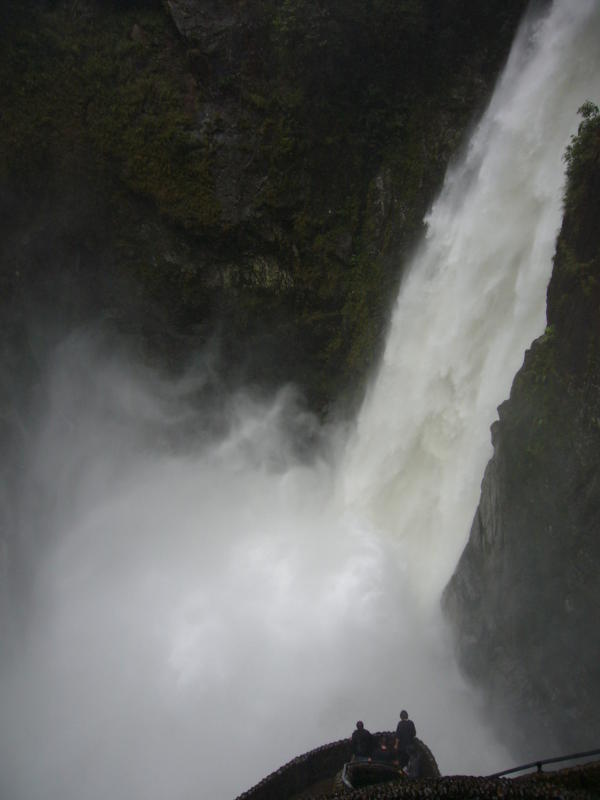
At the end of the route lies the biggest reward of all, Pailon del Diablo. Also known as the Devil’s Cauldron, this is a powerful waterfall, which is titled as a must-see attraction. A steep and quite slippery climb is required to get the best viewpoint, and just being near the waterfall is enough to feel the powerful force of the water crashing:
Peguche Waterfalls
2026 update: Peguche sits inside a small protected forest about 3 km from Otavalo. You can walk from town in 30–40 minutes or take a short taxi ride, and the fall is only a few minutes from the entrance. There is no fixed ticket at the time of writing; most visitors leave a tip of about $1. It pairs well with a morning at the market, covered in our Otavalo market guide.
Otavalo Indigenous Market · from USD 57.50 · 1 day · Tuesdays & Saturdays
Transport from Quito, a bilingual guide and lunch, with stops at the Otavalo market, Cotacachi and Cuicocha crater lake. Peguche is not on this tour’s itinerary, so if the waterfall is a must, stay a night in Otavalo and walk there on your own.
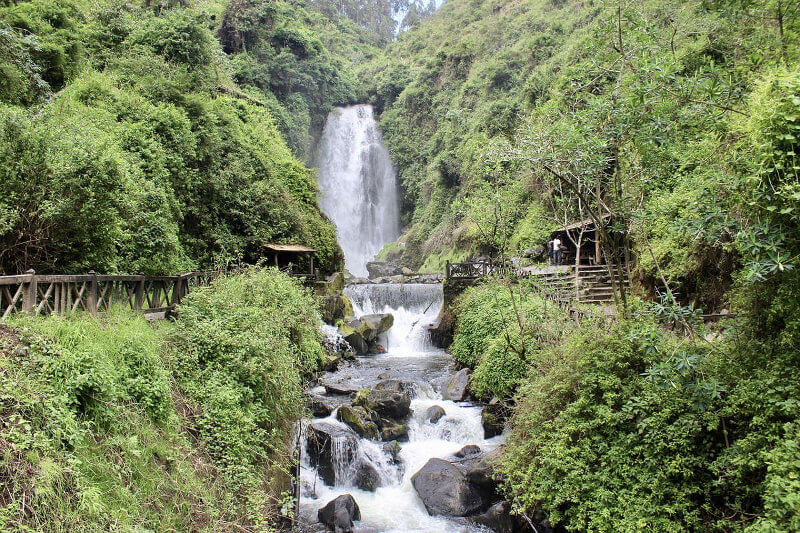
The Peguche Waterfalls in one of the top attractions in Otavalo. This waterfall can be accessed via bus or taxi services, but it is recommended that the trip be made as a hike on foot for the benefit of the full experience. The waterfall measures 18 meters and has quite the symbolic significance.
First, the waterfall is considered as a ceremonial site as the Inte Raymi (Sun and Harvest) annual celebration is preceded by purification baths at the falls. There are also several prominent, albeit strange legends surrounding the waterfall as well. The main legend, which is the strangest, states that there is a bowl made of gold located within the waterfall. This bowl is guarded by two black dogs and is next to the seating place of the devil. He holds a small plate of sand, which is slowly washed away by the waterfall. It is said that when the plate goes empty, the soul of whoever enters the waterfall is taken.
Cascada Condor Machay
2026 update: The trail starts at La Caldera in Rumipamba parish, about 17 km southeast of Sangolquí. Allow about 1.5 hours each way (3 hours round trip) for the 80 m fall. We could not confirm a trail fee; expect to pay about $1 for parking. The last stretch of road is rough, so most travelers hire a taxi from Sangolquí and arrange the pickup time in advance, as there is no phone signal at the end. Rubber boots are the right footwear here.
Also known as El Nino del Condor, this waterfall falls off the Rio Pita river and is within the borders of the Andes. The good news is that while the hiking trail to get to this waterfall is long, it is not strenuous. This is a plus as the Andean location means that the weather is susceptible to various harsh changes in the blink of an eye.
The water here is freezing cold as the Rio Pita river is fed by ice and snow of the Cotopaxi. The trail itself is well maintained as there are numerous bridges crossing the river and lush vegetation to boot.
It is recommended that a guide is used for finding and navigating the area as persons are known to become lost as the path can be unclear.
Cascada Taxopamba
Located in Otavalo via the lagoons of Mojanda, this waterfall has the benefit of a quieter setting as it is not one of the traditional tourist attractions of the city. The hike is relatively short and simple (making it perfect for families), and the countryside aesthetic presents an overall feeling of tranquility which is perfect for activities such as meditation and yoga. The landmark consists of two falls, which measure 15 meters and 10 meters.
The isolation of the location means that there are no shops in the area to purchase supplies, so it is recommended that visitors ensure that they begin their hike with all necessities and a pair of sturdy shoes to combat the terrain. Of course, as it exists within the countryside, the waterfall is surrounded by vegetation.
El Progreso
The El Progeso waterfall is in the town of Bucay on private property, and is accompanied by a restaurant, and a hostel that bear the same name. At 25 meters high, it is one of the smaller waterfalls of the country, however, it is incredibly beautiful, and this beauty is complimented by the variety of greenery in the immediate surrounding.
The admission of $2.00 per person covers a guide (a child native to the area) and the cost of entry. The hike is not particularly difficult as it Is simply walking up and over a close hill which has steps and handrails to promote safety on its more slippery and steeper areas.
Of course, once the hike is conquered, the benefit of relaxing by the falls can be enjoyed.
Las Cascadas de Piedra Blanca
Located 16 kilometers away from Bucay, this area is rumored to have over 40 waterfalls in total. The highest of these is known as Isabelita, which stands at a height of 90 meters. It is relatively simple to access on foot via a flat path, which is cobblestone at times.
Laz Mellizas is another of these waterfalls. This one is a twin waterfall and has a more private feeling than others, boasting even a gazebo complete with seating. The rush of the water is quite heavy and the temperatures border on freezing.
While there are others, these are the two falls in the area that are the most noteworthy.
Cascadas Gallo de la Peña
Also located in Bucay, the extent of the hiking trail’s difficulty rests within the fact that it is a one-kilometre trail with a continuous uphill slope. There are also many crossings along the trail that may have handrails and can be very wobbly at times. At an objectively quick pace, it is possible that this walk can last over an hour. The trail consists of two waterfalls, which are ironically located at the beginning and at the end of the trail.
The Cascada Cueva de la Golondrina is the first of the two waterfalls and is only a few minutes along the trail. It is less than five meters in height, however, it is quite a beautiful note to begin the trail on and to provide inspiration to carry on for the sake of wanting to see what other wonders await.
At the end of the hiking trail there exists the Gallito de la Pena which, unlike its smaller counterpart, reaches a height of 60 meters. This waterfall is a known tourist attraction and so there are usually quite a few persons both along the trail, and at this waterfall. Small paths run around the waterfall’s base allowing it to be viewed from various angles. It should be noted, however, that the water from the falls makes all these areas quite slippery.
Cascada Las Latas
This waterfall is in West Misahualli and is referred to as “Misahualli’s most enjoyable sight.” It is recommended to travel here by boarding a Misahuallli – Puerto Napo bus and getting off at the trail to the falls, known to the locals as “el camino a las cascadas.”
The one-hour trail requires the following of a river upstream and some wading. There are also several swimming holes that will be passed along the way. The sights of nature along this trip are constantly breath taking as flora and fauna alike appeals to the sense of sight, with visitors using the word “paradise” to describe the view. At the end of the trail, there is the reward of jumping into the pool which is a natural one, made up solely of water from the waterfall.
Cascada Magica
Cascada Magica, located in El Chaco, literally translates to “Magic Waterfall”. It is 50 meters high and the sheer pressure of the water creates a cloud that can be seen a few meters from its fall. The water of the fall hails from the Malo River. The trail is about 1.7 kilometers and goes alongside the river and through cane fields. A guide can be hired for this trip who will not only guide you along the trail, but will also offer horseback riding, rappelling, and tubing.
Along the trail, there are many unique species of flora and fauna that can be observed such as chocolate, may flower, the egret of the sun, and the rooster of the rock.
Cascada El Palto
Cascada el Palto is located Vilcabamba, Ecuador and is a waterfall that measures 20 meters in height. Vilcabamba is a tourist attraction that is also known as the Valley of Longevity, as there are many inhabitants that have lived to see at least 100 years.
Horses are available for rent for the travel along the trail, but they are completely optional.
The hiking trail is at least two hours long and even has a small house along the way that exists for camping and/or making food. The trail also has wonderful sites it the form of flora, fauna and a view of a couple mountains from an incredible vantage point. Once at the falls, there is a feeling of crisp, clear air which ties in with the crystal-clear water which can be enjoyed as the trip’s reward.
Cascada de Mundug
The Mundug Waterfall is made up of two waterfalls that have an astounding height of 150 meters, making it one of the tallest waterfalls across the nation. The shape that the water takes as it rushes down the fall resembles a long train on a wedding dress. Its location is in Patate parish, Mundug sector.
From the entrance of the trail, dubbed “Path of Mundug”, a relatively simple walk along the water channel and a 100-meter descent is necessary to enter the waterfall. This trail requires almost an hour to see to completion. The standout sights along the trail are the beautiful birds and orchids that lie along the way. Also, this waterfall is not a popular tourist attraction and so it is usually not very populated. At the end of the trail comes the reward of enjoying the sight of and a dip in the crystal-clear water of the waterfall.
Giron Waterfalls
Located 4 miles from the town of Giron, the “enchanted waterfalls,” as they are described, are two majestic 100-meter high waterfalls that cascade over the rocks and look simply divine doing so. The first of the two waterfalls (El Chorro) is relatively easy to get to as the hike makes use of flatlands and wooden stairs. There is a natural pool at the base of this beautiful waterfall, but swimming is not recommended as the water is always at freezing temperatures no matter how high the temperature in the environment is.
Getting to the second waterfall is where it becomes challenging as no path exists to do this. It is required that the high mountains and rivers are traversed to reach the destination. The second waterfall falls along a semi-circular structure and so it takes the appearance of a curtain along a semi-circular wall.
Mindo
2026 update: Mindo’s main waterfall hike is the Tarabita y Santuario de Cascadas: a cable car crosses 530 m over the Nambillo River canyon, then trails lead to seven falls (Nambillo, Reina, Ondinas, Guarumos, Colibríes, Madre and Maderos). The full hike takes 3–5 hours. The cable car costs about $5 round trip and stops running in the late afternoon, so go in the morning. The trailhead is about 7 km uphill from town; a taxi runs around $6. Our Mindo guide covers the rest of the town.
There are also some waterfalls in Mindo, for example the Nambillo Fall.
Ecuador has some truly beautiful waterfalls, which are all deserving of exploration. However, it’s important to remember that it can get cold, there are sudden weather changes and there is also a lot of water involved, which means it is important to go prepared with the proper footwear and backup clothing, so the experience can truly be enjoyed.
How do you plan a waterfall trip in Ecuador?
Group the falls by region. From Quito you can do Mindo, Cóndor Machay and Peguche as separate day trips. Baños and its Ruta de las Cascadas deserve at least two nights, and Patate (Mundug) is a short drive from there. Misahuallí and Las Latas fit into an Amazon stop around Tena, while Girón and Vilcabamba belong to a southern route through Cuenca and Loja.
If you are building a longer trip, our Ecuador itinerary for 7, 10 or 14 days shows where Baños and Mindo fit, and the Quilotoa Loop guide is the natural next stop after Baños if you still want to walk. For everything else on foot, start with our hiking in Ecuador overview.
Mindo Cloud Forest · from USD 57.50 · 1 day · Fridays
The easiest waterfall day from Quito: we handle the 2-hour drive and the logistics, you do the hiking.
Plan it with us
Not sure which falls fit your dates? Stop by our office at Pedro Fermín Cevallos N6-78 y Olmedo in Quito, or message us on WhatsApp at +593 97 953 3832 (0979533832 in Ecuador) or email info@communitytravel.ec. Our guides will tell you honestly which waterfalls are worth the drive in the current season and which ones you can easily do on your own.
Frequently asked questions
What is the best waterfall hike in Ecuador?
For most travelers it is Pailón del Diablo near Baños, ideally reached by biking the 18 km Ruta de las Cascadas from town. The trail is short, about 1 km, but you get close enough to feel the spray from the suspension bridge. If you want a longer walk, Mindo's Santuario de Cascadas links seven falls in a 3–5 hour cloud forest hike.
Can you still visit San Rafael Falls in Ecuador?
No. San Rafael Falls, once Ecuador's tallest at about 131 m, collapsed on February 2, 2020, when the Coca River broke through the lava rock at its lip. Regressive erosion has kept eating upstream since then, and the old viewpoint trail is closed. Visit Cascada Mágica near El Chaco instead if you are on that road.
How much does it cost to visit Pailón del Diablo?
As of 2026 the Pailón del Diablo is reached through private entrances near Río Verde. The official ecological tour lists $3 for adults and $2 for children, and other entrances charge around $2. Bring cash in small bills. Getting there from Baños costs little: rent a bike for $5–10 or take a local bus toward Puyo and get off at Río Verde.
What is the best waterfall day trip from Quito?
Mindo is the easiest, about 2 hours west of Quito, with a cable car and seven waterfalls in the cloud forest. Cóndor Machay, near Sangolquí, is closer at around 1.5 hours and gives you a real 3-hour round-trip hike to an 80 m fall. Peguche near Otavalo is the shortest walk and combines well with the Otavalo market.
How long is the Mindo waterfall hike?
The full Santuario de Cascadas circuit takes 3–5 hours. You cross the Nambillo River canyon on the tarabita cable car (about $5 round trip), then choose between the trail to Cascada Reina and the main trail past six other falls. The paths are muddy and slippery, so wear shoes with good grip and start in the morning, as the cable car stops in the late afternoon.
Is Peguche waterfall free?
At the time of writing Peguche has no fixed entrance ticket, and most visitors leave a voluntary tip of about $1. The 18–20 m fall sits in a small protected forest about 3 km from Otavalo, a 30–40 minute walk or short taxi ride from town. The fall itself is only a few minutes from the entrance, so it suits families and anyone short on time.