The honest answer: a lot, but nothing is guaranteed
Hi, it’s Marco. “What animals will I see?” is the first thing almost everyone asks me about Cuyabeno. Here’s my honest answer. You’ll see a lot, but this is wild jungle, not a zoo. You go out with your guide to look for animals, and no single one is ever guaranteed.
The good news is that Cuyabeno is one of the richest places on Earth for wildlife. The reserve covers about 590,000 hectares of rainforest, rivers and flooded lagoons. It’s home to more than 500 bird species, about 350 kinds of fish, 10 species of monkey, two species of river dolphin and two of caiman. Because so much of it is water, you explore it by canoe, which makes spotting animals a lot easier than hiking through thick forest.
Your odds also change with the season. From mid-October to about April it’s the dry season. The water is lower, and it’s easier to see land animals and cold-blooded ones like anacondas. The rest of the year the lagoons are full, and the rain usually comes for an hour and then the sun is back. There’s no bad time to go. The season just changes which animals are easier to find.
If you’re still planning your trip, start with my complete Cuyabeno guide.
What kind of monkeys will I see?
Cuyabeno has 10 species of monkey, and monkeys are usually some of the first animals you’ll spot from the canoe. These are the ones you’re most likely to hear about from your guide:
- Squirrel monkeys. Small, fast and noisy, with a white mask around the eyes. They travel in big groups and are often seen near the lodges in the afternoon.
- Woolly monkeys. Big, furry and social. They use their tail like an extra hand to hang from branches.
- Pygmy marmosets, also called pocket monkeys. Only about 14 to 18 cm long, they’re among the smallest monkeys in the world. They like the flooded forest.
- Tamarins, small monkeys that move fast through the branches.
- Titi monkeys. You’ll often hear their calls before you see them.
- Howler monkeys. You may hear their roar at dawn from far across the forest.
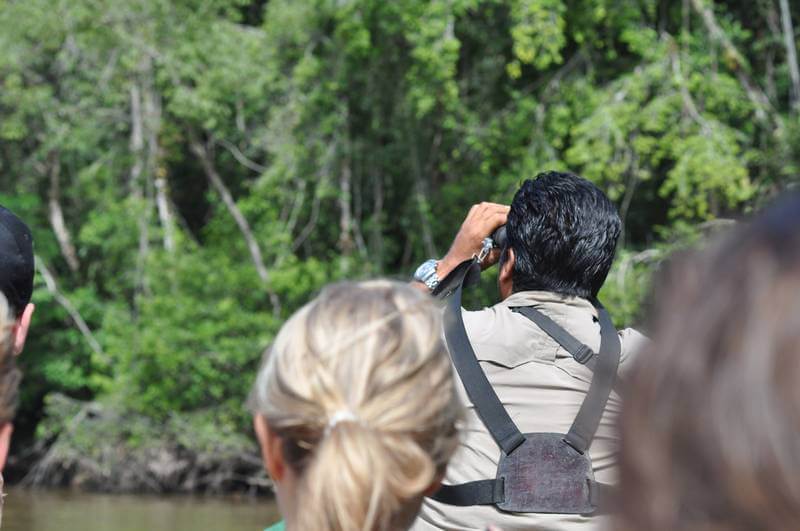
Bring binoculars if you have them. Monkeys are usually high up in the trees, and a good pair makes a big difference.
Anacondas, snakes and caimans
Will I see an anaconda?
Maybe, and I’ll be honest with you: I’ve been to Cuyabeno and I still haven’t seen one myself! Guests do see them, though, and big ones too. Your best chance is the dry season, from mid-October to about April, when the water drops and the anacondas are easier to find.
What kind of snakes will I see?
Most snakes in the jungle are shy and want nothing to do with you, so seeing one is a treat, not a danger. Besides the anaconda, Cuyabeno is home to boa constrictors and many smaller snakes. Some, like the fer-de-lance and coral snakes, are venomous. That’s exactly why you always walk with your guide, wear the rubber boots we give you, and watch where you put your hands.
Are there caimans?
Yes. Cuyabeno has two species, the spectacled caiman and the much bigger black caiman.
Pink river dolphins, piranhas and the water
Will I see pink river dolphins?
You might, and many guests do. Cuyabeno has two kinds of river dolphin, the famous pink Amazon river dolphin and the smaller grey one. When the water is high, they swim right into the flooded forest following the fish. Seeing a pink dolphin surface next to your canoe is one of those moments you’ll never forget. We stay at Cuyabeno Dolphin Lodge, so you’re right in dolphin territory.
Are there piranhas in Cuyabeno?
Yes, piranhas live in the rivers and lagoons, along with about 350 other kinds of fish. But you won’t be fishing for them. Fishing isn’t allowed in Cuyabeno because it’s a protected reserve, and we respect that.
Can I swim with all those animals around?
Yes, you can swim in the lagoon, and it’s one of my favourite things in the world. Jumping in at sunset with the jungle all around you is pure magic. Your guide will show you where and when it’s good to swim.
Spiders, insects and birds
What kind of spiders will I see?
If you’re scared of spiders, don’t worry. They’re not everywhere, and they’re more interested in bugs than in you. Tarantulas are the ones guests get excited about, usually spotted near their burrows or on tree trunks. You may also see orb weavers with huge webs. Your guide knows which ones to admire from a distance.
What about insects?
The insects are half the show. Look for lines of leafcutter ants carrying leaves many times their size, giant blue morpho butterflies, and stick insects that are almost impossible to spot until your guide points them out. Repellent and long sleeves in the evening take care of the mosquitoes.
And the birds?
Cuyabeno is a dream for birders, with more than 500 species. Keep an eye out for the hoatzin, a strange, prehistoric-looking bird that hangs around the lagoon edges, plus blue and yellow macaws, toucans, herons and kingfishers.
What’s the difference between primary and secondary jungle?
This matters more than most people think when you’re choosing a jungle tour.
- Primary jungle is old-growth forest that has never been cleared or logged. The trees are huge, the canopy is closed, and the whole ecosystem is intact, so it holds the most wildlife.
- Secondary jungle is forest that grows back after land has been cleared for farming, logging or roads. It’s still green and pretty, but the trees are younger and smaller, and many of the bigger animals have moved away.
Jungle tours close to towns and roads often take you through secondary forest. Cuyabeno has been a protected reserve since 1979, and much of it is primary forest and flooded forest that you can only reach by canoe. That’s a big reason you see so much more wildlife there.
Quick answers
What animals will I see in Cuyabeno?
Most guests see monkeys, lots of birds and insects, and with some luck pink river dolphins. Anacondas, sloths and caimans are possible too. No animal is guaranteed, because this is wild jungle.
When is the best time to see animals?
There’s no bad time. From mid-October to about April (the dry season) it’s easier to see land animals and anacondas. The rest of the year the lagoons are full and great for canoeing.
Is the wildlife dangerous?
No. The animals keep their distance, and you’re always with a guide who knows the forest. Wear the rubber boots we give you and follow your guide’s lead.
Which tour gives me the best chance to see animals?
The longer you stay, the more chances you get. The 4-day tour is my favourite all-round pick. The 5-day tour adds an extra day of canoeing and an afternoon swimming in the lagoon. See the Cuyabeno jungle tour for prices and dates.
How do I book?
Message us on WhatsApp at +593 97 998 4730, and you’ll be talking to a real person on our team in Quito. We can also plan a private Cuyabeno tour for your group, with pickup and drop-off wherever you’re staying in Quito. For us it’s not about selling you a tour. It’s about you having the best experience you can while you’re in Ecuador.