Quick answer: Baños de Agua Santa is a spa and adventure town about 3–3.5 hours south of Quito by bus ($4–5 from Quitumbe terminal). The Termas de la Virgen hot springs cost $4–6, the Casa del Árbol swing $1, and Pailón del Diablo waterfall $3–5 depending on the entrance. Tungurahua volcano has been quiet since 2016 and is classed as active, not erupting.
Updated September 2026 by our local guides in Quito: this 2017 article was first written for people thinking of moving to Baños. We added current transport, entry fees and the volcano’s status for travelers, and flagged the older prices below.
Baños at a glance (2026)
| Topic | What to know (as of 2026) |
|---|---|
| Getting there from Quito | Bus from Terminal Quitumbe (south Quito), about 3–3.5 h, $4–5. Companies include Transportes Baños, Expreso Baños, Amazonas and others, departing every 45 min to 2 h |
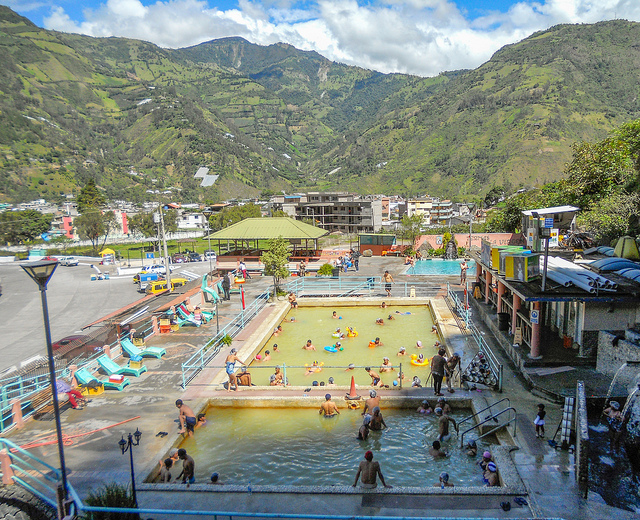
| Termas de la Virgen (hot springs) | Natural pools: $4 adults, $2 children, 5:00–16:00 and 18:00–21:30. Renovated complex: $6 adults, $3 children, Wed–Fri 14:00–20:30, weekends and holidays 10:00–20:30. Swimsuit and swim cap required |
| Casa del Árbol (tree house swing) | $1 adults, about 11–12 km uphill at 2,660 m. Luna Sánchez buses leave near the central market several times a day |
| Pailón del Diablo waterfall | $3–5 adults depending on the entrance, $2 children, about 17 km from Baños in Río Verde, open 8:00–22:00; allow 2 h |
| Ruta de las Cascadas | Bike rental about $10/day, or the open-sided chiva bus about $5; public buses back from Río Verde $0.50–1.50 |
| Tungurahua volcano | Last eruptive period ended in 2016; reclassified from “erupting” to “active” in 2018 (IG-EPN) |
| Best for | Hot springs, waterfalls, cycling, canyoning and rafting, a base for the Amazon (Puyo is about 1.5 h away) |
As seen on: Huffington Post
By Suzan Haskins, InternationalLiving.com
This article comes to us courtesy of InternationalLiving.com, the world’s leading authority on how to live, work, invest, travel, and retire better overseas.
She’s a wanton woman with a feather beneath her skirt, cause for her constant state of libidinous arousal. Men and women alike are smitten with her overpowering beauty and limitless energy. But she has a temper, this one. When her flirtations are not returned, her anger boils and she quite literally blows her top like nothing you’ve ever seen.
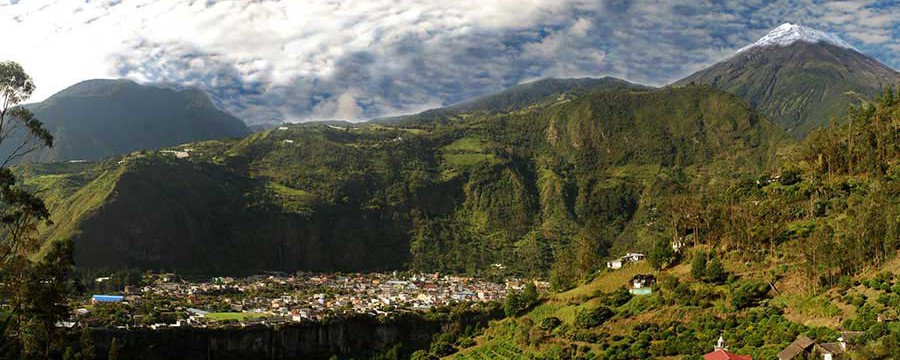
So goes the Quechua legend of “Mama” Tungurahua, the hot and bothered volcano that regally rises from lushly-forested terrain about a three-hour’ drive south from Ecuador’s capital city of Quito.
Perched just five miles from Mama’s summit on her northern side is the town of Baños (population about 20,000). As the lore goes, Baños is Mama’s love child, and she protects it. She’s certainly passed on an inheritance, for—thanks to Tungurahua’s hot temper—Baños is blessed with an abundance of thermal waters. Those waters, and the stunning natural setting, have made Baños a popular spa and outdoor-sports town, as well as home to a small community of expats.
The town’s full name is Baños de Agua Santa: the holy water Baths. (And note, Baños does not mean “bathrooms.” It means “baths,” like the kind you soak luxuriantly in.) The name gives tribute not to Mama, of course, but rather to the town’s other famous patron, the Virgin Mary.
Nuestra Señora de Agua Santa—our Lady of the holy water—is said to have appeared at nearby waterfalls from time to time, and it’s believed she protects those who invoke her name during times of crisis. “Our lady watches over us,” a local man said in a television interview, speaking of the Virgin after Mama’s most recent pyroclastic fit.
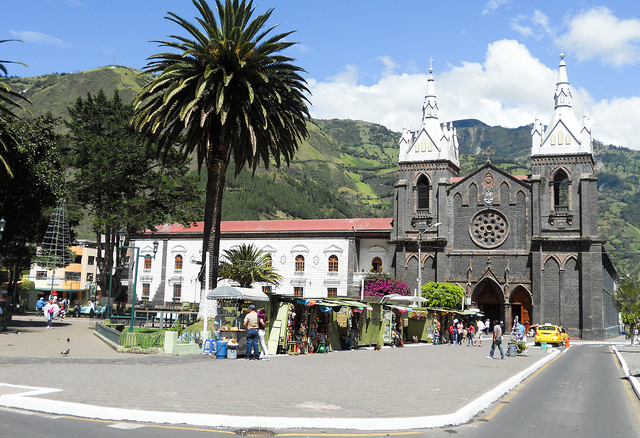
The neo-Gothic Basilica Reina Del Rosario De Agua Santa—built to honor the Virgin—is a local pilgrimage site, and is decorated with graphic artwork of the many miracles she’s credited with. Appropriately enough, the Basilica, which sits in the heart of Baños, is constructed of volcanic rock from Tungurahua.
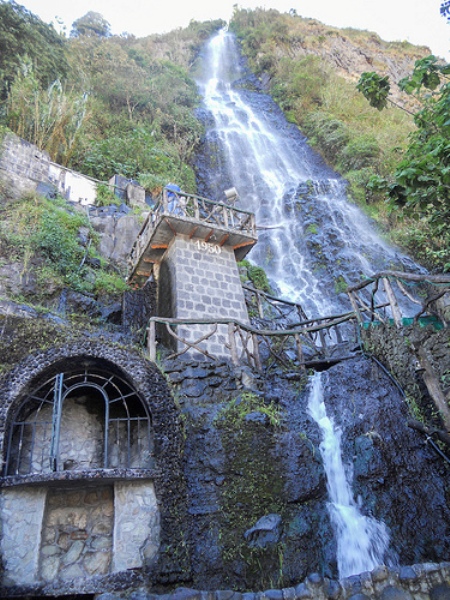
For many visitors, though, Baños’s thermal baths are miracle enough. You’ll find several places to soak away to your heart’s content here, in pools of varying degrees of delicious heat. The most popular public baths are right in town at the base of the 260-foot waterfall called Cascada de la Virgen, where Nuestra Señora allegedly once appeared. A shrine there is dedicated to her and her healing waters.
For certain, water is plentiful in this part of Ecuador. More than 60 waterfalls cascade into the surrounding countryside from the slopes of the volcano. The entire province, called Tungurahua in honor of you-know-who, is fully and self-sufficiently powered, thanks to the Tungurahua hydroelectric facility located just outside Baños.
The surrounding landscape is crisscrossed with steep bluffs, deep river gorges, and expansive plateaus. With all this natural beauty, it’s no wonder that Baños, cupped in a small valley at about 5,900 feet above sea level, is a thriving tourist town, equally popular with both Ecuadorian and international visitors. And with more than 100 hotels and hostels and a nearly continuous round of parades, festivals, and special events throughout the year, the mood in Baños is always festive and
upbeat.
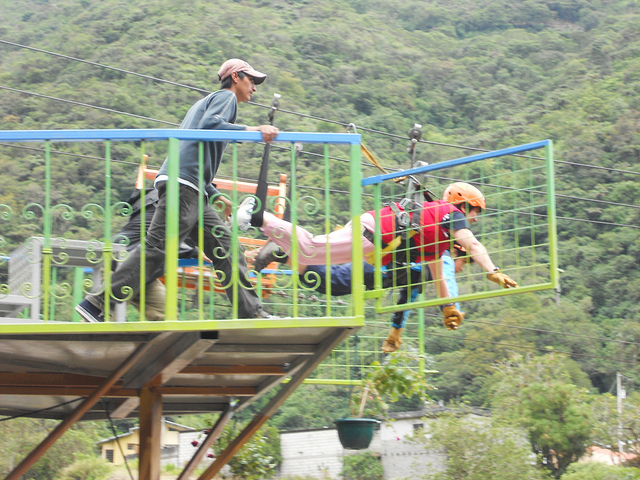
You’ll find just about any outdoor activity that exists: hiking, canyoning and rappelling, bungee jumping, zip-lining…how about a breathtaking ride in a tarabita (cable car) that swings from a mile-long cable across 500-foot-deep gorges? You can go mountain biking, horseback riding, rent an ATV or dirt bike, or just kick back in one of the many spas offering massages, facials, and more.
Water sports are popular, too, of course. Kayaking, white-water rafting, and more can all be enjoyed within just a few miles of Baños. The town, considered one of the safest in Ecuador, is also known as the “Gateway to the Amazon.” Just 30 miles downhill from Baños is the town of Puyo, the country’s largest jungle town. Puyo sits on the banks of the Puyo River, which eventually dumps into the vast Amazon River.
Still, for all its near-perfect, year-round weather (temperatures average 55 F at night up to about 80 F during the day) and wealth of activities and attractions, Baños is not high on the radar for expats looking for retirement destinations.
There is, though, a small and fairly active group of Canadian, European, and U.S. residents in Baños. Mountain-biking enthusiasts Jim and Marshia Redd had traveled to the area many times from their home in Chicago before they decided to purchase La Posada del Arte in 2004.
The hotel has been a successful venture for them, they say. A couple of years ago they bought an adjacent property and expanded to double the hotel capacity. “This has been a fantastic investment,” Jim says. “It pays for itself every two years.”
Additionally, Marshia is president of Fundación Arte del Mundo, a non-profit foundation that operates an after-school library and theater for local children. They’ve opened the Stray Dog Brewpub with their son, Jason.
Likewise, Canadians Rob Tiessen and Robyn Moulyn had traveled all over Ecuador before finding themselves in Baños six years ago with their then-teenaged children. An artist who specializes in wildlife, Robyn fell in love with the natural surroundings and awe-inspiring vistas. (See her website here.) She recently finished the illustrations for a book and is making her own art paper from abundant local banana stalks.
Rob still works in the oil industry in Canada. Even with traveling back and forth for assignments, they say that by living in Ecuador, they spend less money and enjoy life more.
“What I find fascinating about Baños,” Robyn says, “is that, for being such a small town, it’s very much aware of its international appeal and caters to that with its friendliness and care of the tourists. And did I mention the variety of foods available? From vegetarian to French cooking. We have it all.”
All the attributes, in fact, that make Ecuador an attractive retirement destination can be found in Baños. The cost of living is low…a couple can live comfortably just about anywhere in Ecuador on $1,500 to $2,000 a month. The average furnished rental costs $300 to $500 a month.
A local mercado (farmers’ market) just two blocks from the basilica is open every day. There you can find all the fresh local produce you might want, and at a fraction of the price you’ll pay in the States, where it’s all imported, of course.
Health care in Baños is adequate, as you might expect in a town that caters to adventure tourism. And a new hospital is being built. For now, though, for anything of a serious nature, you’ll need to travel an hour away to the larger city of Ambato, or to Quito.
Certainly, don’t go to Baños expecting to find a mature real estate market. While there are certainly properties for sale, there is only one official real estate company. You’ll need good Spanish chops to communicate with the proprietor and his staff. The website listed on the business card they gave me doesn’t work, making it hard to get a handle on area prices.
But with a bit of digging, we found one 1,400-square-foot, three-bedroom, one-bath house in a typical local neighborhood selling for just $47,000. It’s perfectly habitable but will certainly require some upgrading to make it something I’d personally appreciate.
Another more likely candidate is near the Río Pastaza. A red-brick house of 2,600 square feet with a red-tile roof, it has four bedrooms and five baths and is selling for $90,000. Two nearby lots that border the river, each 1,700 square feet in size, are listed for $8,000 each.
And on a quarter-acre lot with a view of Mama Tungurahua herself, a 3,550-square-foot house, with four bedrooms, four bathrooms, and even a small pool, is selling for $120,000. It’s lovely inside, with tile floors and cantilevered wooden ceilings, and will require little, if any, improvements.
A Quick Guide for Taking the Cure in Baños
2026 update: The cost-of-living, rent and house prices above come from the original 2017 article and are out of date, so treat them as history, not a guide. On the volcano: Tungurahua’s eruptive cycle ended in 2016, and in 2018 the Instituto Geofísico (IG-EPN) reclassified it from “erupting” to “active”. Its February 2026 assessment does not expect a reactivation in the short or medium term. Evacuation route signs are still posted around town, and it is worth knowing where they lead.
How to Get There:
2026 update: The bus from Quitumbe now costs about $4–5 (not $3.60) and takes 3–3.5 hours, with fares higher on holiday weekends. We could not verify the old van reservation phone numbers, so do not rely on them. A private transfer from Quito is still the fastest option; ask for a current quote.
Catch a bus to Baños from Quito’s Quitumbe Station for $3.60, or via a door-to-door shared van for $20 per person plus $5 for a large bag. To reserve, call 022-082-165 / 099-048-9374 / 098-752-9599. A private taxi from Quito will cost $70 to $80.
Where to Stay:
2026 note: The room rates quoted here are from 2017. Baños now has hundreds of hostels and hotels, with dorm beds commonly around $10–15 and simple doubles from about $30. Book ahead for Carnival, Easter and long weekends, when domestic tourists fill the town.
You won’t have trouble finding accommodation in all price ranges in Baños. We’d recommend La Floresta at $58 for a double or La Posada del Arte at $65 to $70 for a double. Both include breakfast. For upscale accommodation in hotels with private thermal pools and up-close views of Tungurahua, check out Luna Runtun or Hotel Sangay.
Where to Eat: There are many excellent restaurants in Baños. Popular Café Hood is owned by U.S. expat and longtime Baños resident Ray Hood. (Not to be confused with Casa Hood, also good.) We also had a most enjoyable meal at the antique-filled Café Mariane.
Don’t Miss:
2026 update: The waterfall bus tour is now usually an open-sided chiva for about $5 per person. Most travelers rent a bike instead (about $10 a day), ride the mostly downhill Ruta de las Cascadas past the Manto de la Novia to Pailón del Diablo ($3–5 entry), and take a bus or pickup back uphill with the bike.
A visit to the Basilica is a must. And for $6 per person, take the full-day, double-decker bus excursion that will take you to the most famous sites. These include waterfalls and canyons where you can ride the cable cars or go zip-lining. (Be sure to reserve a seat on the top deck and don’t forget your rain gear. And definitely try the empanadas!)
Related Articles:
The Top 5 Cultural Experiences In Ecuador
Ecuador’s Natural Weight Loss Plan…
How Much Does It Cost To Live In Ecuador?
How do you visit Baños from Quito in 2026?
Take a taxi or the Trole south to Terminal Quitumbe and buy a ticket to Baños at any of the company windows. Buses run roughly every hour, the ride takes 3–3.5 hours, and fares are about $4–5 as of 2026. Give Baños at least two nights: one day for the Ruta de las Cascadas and Pailón del Diablo, one for the Casa del Árbol and an evening soak at the Termas de la Virgen.
Baños sits on the Avenue of the Volcanoes, so it pairs naturally with Cotopaxi and Quilotoa on the way south. We do not run a Baños tour ourselves, but our two-day trip covers the two highlights most travelers try to fit in before or after.
Cotopaxi & Quilotoa 2 Day Adventure · from USD 170 pp · 2 days / 1 night · departures Wed–Thu, Thu–Fri, Sat–Sun
Transport from Quito, a bilingual guide, a night in a lodge on the Avenue of the Volcanoes, meals and a mountain bike ride at Cotopaxi. A good way to see the high Andes before you head down to Baños on your own.
Related guides
- The best waterfalls in Ecuador, including Pailón del Diablo
- Hiking in Ecuador
- Cotopaxi and Quilotoa: the complete guide
- Tena whitewater rafting guide
- Ecuador itinerary for 7, 10 or 14 days
Plan it with us
Questions before you go? Stop by our office at Pedro Fermín Cevallos N6-78 y Olmedo in Quito, message us on WhatsApp at +593 97 953 3832, or write to info@communitytravel.ec. Our local guides answer every message and will tell you honestly whether a tour or the bus makes more sense for your trip.
Frequently asked questions
How do I get from Quito to Baños?
Take a bus from Terminal Quitumbe in south Quito. Several companies, including Transportes Baños and Expreso Baños, run the route every 45 minutes to 2 hours. The trip takes about 3–3.5 hours and costs around $4–5 as of 2026, a little more on holiday weekends. Buy your ticket at the terminal window on the day.
Is Tungurahua volcano still erupting?
No. Tungurahua’s long eruptive period, which began in 1999, ended in 2016. In 2018 Ecuador’s Instituto Geofísico (IG-EPN) changed its status from “erupting” to “active”, and its February 2026 assessment does not expect a reactivation in the short or medium term. It remains monitored, and Baños keeps its evacuation routes signposted.
How much are the hot springs in Baños?
At the Termas de la Virgen, the natural pools cost $4 for adults and $2 for children (open 5:00–16:00 and 18:00–21:30). The renovated complex next door costs $6 for adults and $3 for children. A swimsuit and swim cap are mandatory, and caps are sold at the entrance. Evening soaks are the most popular.
How much does it cost to visit Pailón del Diablo?
Entry to Pailón del Diablo costs about $3–5 for adults depending on which private entrance you use in Río Verde, about 17 km from Baños; the official ecological tour lists $3 for adults and $2 for children. It is open 8:00–22:00. Allow about two hours for the trails, including the path that takes you behind the falling water.
Is the Casa del Árbol in Baños worth it?
If you want the famous swing photo and views of Tungurahua, yes, and it is cheap at $1. It sits about 11–12 km above town at 2,660 m. Go early on a clear morning, since clouds usually cover the volcano by midday. Luna Sánchez buses leave near the central market several times a day, or take a taxi.