Quick answer: Otavalo Market runs every day from about 7am to 6pm in the Plaza de los Ponchos, two hours north of Quito, but Saturday is the big day: stalls spill into the surrounding streets and the animal market starts around 6am. Buses leave Quito’s Carcelén terminal several times an hour for about $3–4 each way.
Updated September 2026 by our local guides in Quito.
| Otavalo at a glance | Details (as of 2026) |
|---|---|
| Location | Imbabura province, about 90 km north of Quito, 2,550 m above sea level |
| Plaza de los Ponchos hours | Daily, roughly 7am to 6pm |
| Biggest market day | Saturday (Wednesday is the second busiest) |
| Animal market | Saturdays only, from about 6am, winding down by 10–11am |
| Public bus from Quito | Carcelén terminal, about 2 hours, around $3–4 each way |
| Our guided day tour | From USD 57.50, Tuesdays and Saturdays, back in Quito around 6:30pm |
| Nearby sights | Peguche Waterfall (free, donation), Cuicocha crater lake (free entry), Parque Cóndor ($6) |
What Is Otavalo Market?
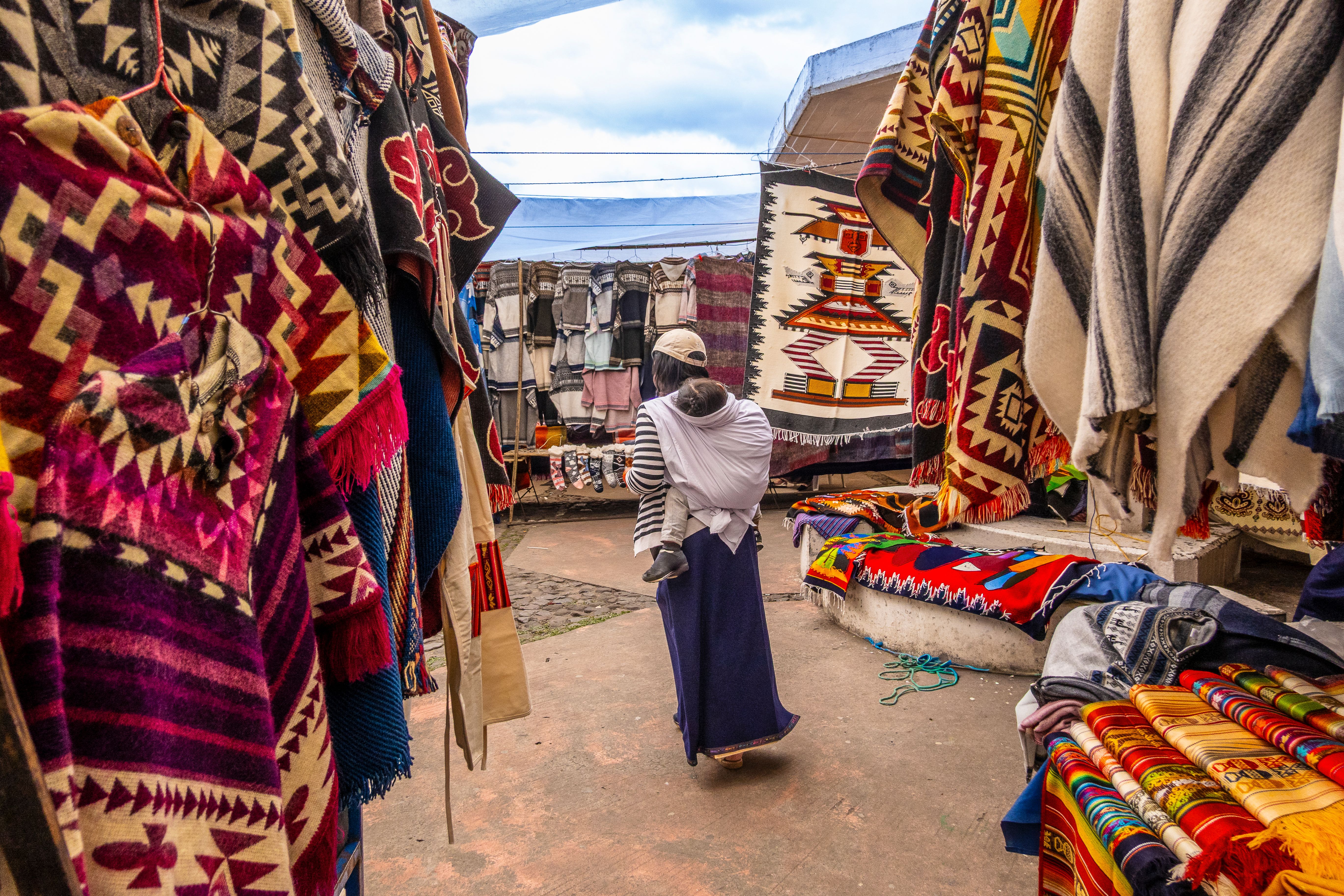
Otavalo Market is a daily crafts and textile market run mostly by Kichwa Otavalo families in the town of Otavalo, a highland town about two hours north of Quito. It is often called the largest indigenous market in South America, and on a Saturday it is easy to see why.
Unlike many “tourist markets,” Otavalo has been a trading hub for the local Kichwa community for centuries, since long before the Inca arrived. It is still where many Ecuadorian families buy blankets, sweaters and ponchos, and where Otavalo weavers sell work they later export across the Americas and Europe.
The heart of it is the Plaza de los Ponchos, a square in the town center packed with covered stalls. Around it you will find the municipal food market, bakeries and small shops selling school uniforms and hardware, which is a good reminder that this is a working town, not a set.
Best Day to Visit Otavalo
Saturday is the best day to visit Otavalo if you want the full experience, and any other day works if you prefer calm browsing.
- Saturday: the biggest market day, when the Plaza de los Ponchos expands into the surrounding streets and a separate animal market runs early in the morning just outside town.
- Wednesday: also busy, with a good range of stalls and smaller crowds than Saturday.
- Other days: the Plaza de los Ponchos operates daily, roughly 7am to 6pm, with fewer stalls but a much more relaxed pace.
| Day | Crafts market | Animal market | Crowds |
|---|---|---|---|
| Saturday | Full size, fills nearby streets | Yes, about 6am to 10–11am | High, especially 10am to 3pm |
| Wednesday | Large | No | Medium |
| Sunday to Friday (other days) | Plaza only, fewer stalls | No | Low |
The Saturday animal market
The animal market is a livestock fair on the edge of town, near the Panamericana, where families from the surrounding communities trade cows, pigs, sheep, guinea pigs and chickens. It starts around 6am and most trading is done by 10 or 11am, so older guides that say it runs until noon are optimistic.
It is muddy, noisy and not staged for visitors. Wear closed shoes, ask before photographing people, and be aware that animal handling is rougher than many travelers are used to.
What to Buy at Otavalo Market
The best buys at Otavalo are woven textiles, followed by jewelry, bags and hammocks.
- Hand-woven alpaca and wool textiles: scarves, blankets, ponchos and sweaters
- Traditional Andean jewelry and beadwork, including the gold-colored glass bead necklaces (gualcas) worn by Otavaleña women
- Tagua jewelry and carvings, made from a hard palm nut sometimes called vegetable ivory
- Leather goods, bags and hats (for serious leather, Cotacachi is 15 minutes away)
- Hammocks, tapestries and home decor
Be realistic about “alpaca.” Most sweaters and scarves sold as alpaca are sheep wool, acrylic or a blend. Real alpaca feels softer and less scratchy and costs a lot more, so if a sweater is $20, assume it is not pure alpaca and judge it by how it feels.
How much do things cost at Otavalo Market in 2026?
Most souvenirs at Otavalo cost between $2 and $40, and larger textiles or hammocks run higher. The ranges below are typical asking prices our guides see in 2026; they are not fixed prices and vary with size, material and your bargaining.
| Item | Typical price range (USD, 2026, indicative) | Notes |
|---|---|---|
| Scarf (wool or blend) | $5–15 | Pure alpaca costs noticeably more |
| Sweater (wool or blend) | $15–35 | Genuine alpaca often $80+ |
| Poncho | $15–40 | Small ones start around $15 |
| Blanket or tapestry | $15–50 | Heavier weaves cost more |
| Tagua jewelry | $2–15 | Earrings at the low end, carved pieces higher |
| Hammock | $20–60 | Check the weave and end loops |
| Felt hat | $10–20 | Toquilla straw “Panama” hats come from the south coast and Cuenca |
| Coin purse or small bag | $1–5 | Good for small gifts |
Bargaining is expected and generally friendly. Starting around 20–30% below the asking price is normal, and you will usually settle a little above that, especially if you are buying multiple items.
How to Get to Otavalo from Quito
The easiest independent way to get to Otavalo from Quito is a direct bus from the Carcelén terminal in the north of the city, about 2 hours and $3–4 each way.
Otavalo is roughly 90 km from Quito on the Panamericana Norte. Several cooperatives run the route, and buses leave frequently from early morning into the evening, so you rarely need to book ahead except on long weekends and holidays. Some buses bound for Ibarra or Tulcán stop only on the highway at Otavalo, so ask for a direct Otavalo bus that goes into the town terminal.
Getting to Carcelén is the slow part. A taxi from the Old Town or La Mariscal usually costs around $10–15 and takes 30–60 minutes depending on traffic. Leave early on Saturdays, because the midmorning buses fill up.
The alternative is a guided day tour that combines the market with nearby stops. Ours adds Cayambe bizcochos, the Quitsato sundial on the equator, a lake viewpoint, lunch and leather shopping in Cotacachi, and Cuicocha crater lake.
| Option | Cost (2026) | Time | Best for |
|---|---|---|---|
| Public bus from Carcelén | About $3–4 each way, plus taxi to the terminal | About 2 h each way | Budget travelers, overnight stays |
| Guided day tour | From USD 57.50 with lunch | 7:10am to about 6:30pm | Seeing the market plus Cotacachi and Cuicocha in one day |
| Private driver | Varies, agree the price in advance | About 1.5–2 h each way | Families and small groups |
Tips for Shopping Otavalo Market
The best way to shop Otavalo is to arrive early, carry small bills and walk the whole plaza before you buy.
- Arrive by mid-morning (10–11am) for the best selection before vendors start packing up in the late afternoon.
- Bring small bills. Many vendors cannot break $20 notes, and $50 and $100 bills are hard to use anywhere in Ecuador.
- Wear comfortable shoes; the market spans several blocks of cobblestone streets.
- Stay overnight in Otavalo if you want to browse before the day-trip crowds arrive.
- Keep your phone and wallet in a front pocket. Crowded Saturday aisles attract pickpockets, as any busy market does.
- Ask before taking photos of vendors or their children. Most people will say yes if you are buying or simply ask kindly.
Local tip: Walk one full loop of the Plaza de los Ponchos before buying anything. The same scarf often appears at five stalls, and prices drop as you move away from the corners nearest the main street. Buying two or three items from one vendor gets you a better deal than haggling hard over one.
Beyond the Market: What Else to Do in Otavalo
If you have extra time, combine your market visit with Peguche Waterfall, San Pablo Lake, Cuicocha crater lake or the nearby leather town of Cotacachi for a fuller day in the region.
| Place | Distance from Otavalo | Entry (2026) | What to know |
|---|---|---|---|
| Peguche Waterfall | About 3 km; 30–40 min walk or $2–3 taxi | Free, small donation welcome | An 18 m waterfall in a eucalyptus forest, sacred in the Inti Raymi celebrations |
| Laguna Cuicocha | About 30 min by road, past Cotacachi | Free entry; boat ride about $3.25 | Crater lake at about 3,070 m; the rim trail is about 14 km, 4–5 h |
| Parque Cóndor | About 15–20 min uphill by taxi (around $4) | $6 adults, $3 children | Bird of prey rescue center, open Wed–Sun 9:30am–5pm, flight shows 11:30am and 3:30pm |
| San Pablo Lake | About 10–15 min by road | Free to view | Wide lake at the foot of Imbabura volcano, good for a lakeside lunch |
| Cotacachi | About 15 min by road | Free | Street of leather shops; jackets, bags and belts |
Cuicocha sits inside the Cotacachi-Cayapas Ecological Reserve, and entry is currently free. The full rim hike is one of the best day hikes in northern Ecuador; see our hiking in Ecuador guide for more trails. For other falls near Otavalo and beyond, read our guide to the waterfalls of Ecuador.
If you are continuing north, Laguna Yahuarcocha near Ibarra is 30 minutes further, with a history worth knowing before you go: the dark history of Laguna Yahuarcocha.
Is Otavalo worth a day trip or should you stay overnight?
Otavalo works well as a day trip from Quito, and staying one night is worth it if you want the Saturday animal market or the Cuicocha hike.
On a day trip you get 2–3 hours in the market plus one or two nearby stops. With a night in town, you can see the animal market at 6am, shop before the tour buses arrive around 10am, and hike Cuicocha in the afternoon. If you only have one Saturday in Ecuador and like markets, spend it here.
Otavalo is also a gentle place to acclimatize. At 2,550 m it is lower than Quito, so it is a good early trip; read our altitude sickness guide if you are just arriving.
Otavalo Indigenous Market tour · from USD 57.50 · 1 day · Tuesdays and Saturdays
Pickup 7:10am at Plaza Foch or 7:20am at Plaza San Blas, with stops in Cayambe, the Quitsato sundial, Otavalo market, lunch and leather shops in Cotacachi, and Cuicocha lake. Transport, bilingual guide and lunch included; Quitsato ($5) and the boat ride ($3.25) are extra.
Skip the guesswork and explore Otavalo with a local guide on our Otavalo Indigenous Market Tour, or browse all our tours from Quito.
Related guides
- Mitad del Mundo: the history and the monuments
- One perfect day in Quito’s Old Town
- How much a trip to Ecuador costs in 2026
- Is Ecuador safe to travel in 2026?
- Ecuador travel facts 2026
Plan it with us
Want help planning Otavalo or the rest of northern Ecuador? Visit our office at Pedro Fermín Cevallos N6-78 y Olmedo in Quito, message us on WhatsApp at +593 97 953 3832, or email info@communitytravel.ec. Our guides live here and are happy to share what is working this month.
Frequently asked questions
Is Otavalo Market open every day?
Yes. The crafts market in the Plaza de los Ponchos is open every day, roughly 7am to 6pm. Saturday is by far the biggest day, when stalls fill the surrounding streets and the animal market runs early in the morning. Wednesday is the second busiest. On other days you will find fewer stalls but calmer browsing and vendors with more time to talk.
How much is the bus from Quito to Otavalo?
As of 2026 a direct bus from Quito’s Carcelén terminal to Otavalo costs about $3–4 each way and takes around 2 hours. Buses leave several times an hour from early morning. Budget another $10–15 for a taxi from the Old Town or La Mariscal to Carcelén, which can take up to an hour in traffic.
What time does the Otavalo animal market start?
The animal market runs on Saturdays only, on the edge of town near the Panamericana. Trading starts around 6am and most of it is finished by 10 or 11am. To see it you realistically need to sleep in Otavalo on Friday night, because the first buses from Quito arrive after the busiest hour.
Is the alpaca at Otavalo Market real?
Mostly not. Many items labeled alpaca are sheep wool, acrylic or blends. Genuine alpaca is softer, less scratchy and much more expensive, often $80 or more for a sweater. Buy what you like at a price that feels fair for the quality in your hands, rather than paying a premium for a label you cannot verify.
Can you do Otavalo and Cuicocha in one day from Quito?
Yes. Leave Quito by 7am and you can spend two to three hours at the market, have lunch in Cotacachi and stop at Cuicocha crater lake before heading back around 5pm. Our Otavalo day tour follows this route and returns to Quito around 6:30pm. Hiking the full 14 km Cuicocha rim trail needs an overnight stay.
Do vendors at Otavalo accept credit cards?
Most stalls take cash only, in US dollars, and prefer small bills. A few larger shops accept cards, sometimes with a surcharge. There are ATMs around the town center, but lines get long on Saturdays, so withdraw what you need in Quito and carry $1, $5 and $10 notes.